
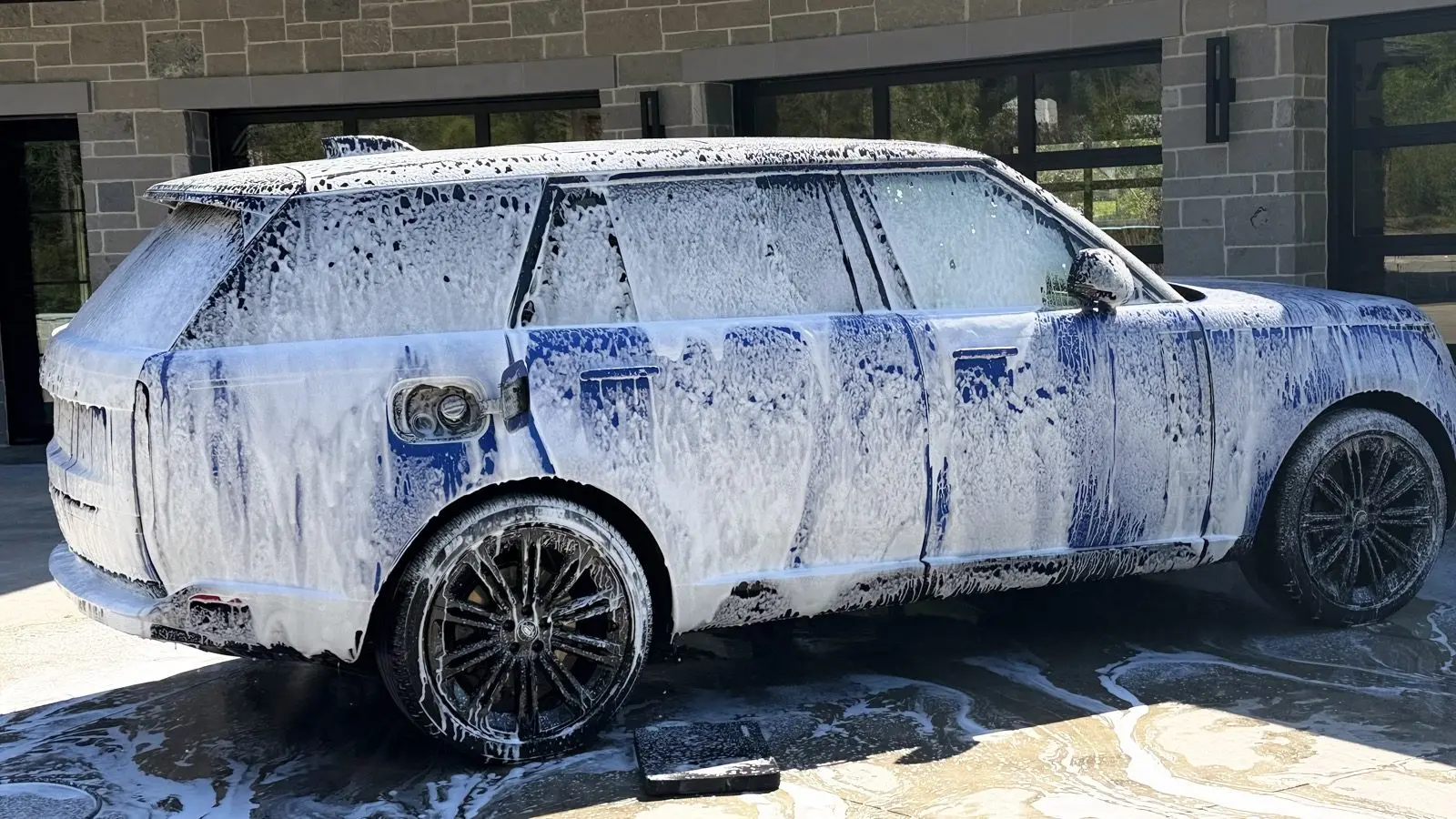
You wash your car, it dries in Houston's heat — and instead of a clean finish, you get dozens of white, hazy spots all over the hood and roof. Sound familiar? This is one of the most common paint problems in Houston, and it's almost entirely caused by the city's hard water supply.
Why Houston's Water Causes Spots
Houston water comes from the Gulf Coast Aquifer and surface sources, and it's loaded with dissolved minerals — primarily calcium and magnesium. When water droplets dry on your paint in the sun, the water evaporates but the minerals stay behind. They bond to your clear coat and, over time, can etch into it.
The faster your car dries, the worse the spotting. What would be a minor issue in a cooler climate becomes a recurring problem in Houston, because a droplet on a hot panel goes from liquid to mineral residue in under a minute — there is no window in which you could have wiped it away.
The three sources that cause almost all of it
- Air-drying after a wash. The most common cause and the most preventable. Rinse water is tap water, and tap water is mineral water.
- Sprinkler overspray. The worst of the three, because it hits the same panels on the same side of the car every single day. Sprinkler water is often harder than indoor tap water, and the deposits build in layers until they look like a permanent film.
- Rain that dries in the sun. Rain itself is soft, but by the time it reaches your paint it carries dust and airborne pollutants, and it lands on a hot panel. Anything dissolved in it gets left behind and baked on.
Type 1: Surface Water Spots (Easy to Fix)
Fresh mineral deposits that haven't had time to etch into the clear coat. You can feel them as a slightly rough texture, and they look white or hazy in direct sunlight.
How to remove:
- Wash the car first with a pH-neutral soap
- Mix 1 part white distilled vinegar with 3 parts distilled water
- Apply to the affected areas with a microfiber cloth, let sit 60 seconds
- Rinse thoroughly and dry immediately with a clean microfiber
- Apply a spray wax or detailer to protect the area
Work one panel at a time, in the shade, on a cool surface. Never let the vinegar solution dry on the paint — the whole point is to dissolve mineral and then get it off, and a solution that dries in place just deposits everything again. This works on light, fresh spots. Do not use vinegar on etched spots — it won't help and can make things worse on bare clear coat.
Type 2: Etched Water Spots (Require Professional Correction)
When mineral deposits sit on paint — especially in direct sun — the acidic compounds in the water chemically etch into the clear coat. You can see this as a circular mark that doesn't come off with washing or vinegar. Running your finger over it, you might feel a slight depression.
How to remove: This requires machine polishing (paint correction). A compound or polish and a machine polisher can level the clear coat around the etch and restore a smooth, uniform surface. This is not a DIY job unless you have experience with a DA polisher — wrong technique can burn through the clear coat, and clear coat is the only layer standing between UV and your color.
There is a limit worth understanding: correction works by removing a very thin layer of clear coat to bring the surface down level with the bottom of the etch. If the etch is deeper than the clear coat can safely give up, the honest answer is partial improvement rather than a perfect fix. That's one reason to deal with spotting early rather than after a summer of it.
Type 3: Embedded Mineral Deposits (Require Clay Bar + Correction)
Long-term buildup that's bonded to and into the clear coat. Paint will feel rough to the touch even after washing. This needs a full decontamination — an iron fallout remover followed by a clay bar or clay mitt — before any polishing happens, because polishing over embedded grit drags that grit across the paint.
Glass and wheels spot too
Windshields are often worse than paint, because glass is porous enough to hold mineral and nobody protects it. Spotting on glass shows up as glare and haze when you're driving into low sun, and it responds to a dedicated glass polish rather than to washing. Wheels get it as well, particularly where a sprinkler hits them, and mineral baked onto a hot brake-dusty wheel face is one of the more stubborn things to remove safely.
How to Prevent Water Spots in Houston
- Dry your car immediately after washing — don't let it air dry, especially outside in summer. Use a clean microfiber drying towel and go over it immediately after rinsing.
- Use a ceramic coating or paint sealant — coated surfaces are hydrophobic. Water beads and rolls off instead of sitting and drying flat, so far less mineral is left on the panel to begin with, and what does land sits on the coating rather than on your clear coat. This is the single biggest prevention tool for Houston water spots. See ceramic coating for what that involves.
- Use distilled water for the final rinse — especially if you wash at home. Regular tap water is the enemy. A gallon of distilled from the grocery store for your final rinse costs about a dollar and prevents hours of correction work.
- Fix the sprinkler. If a head is hitting your parking spot, rotate it or move the car. This single change eliminates the most persistent source of spotting we see on driveway-parked vehicles.
- Park covered whenever possible — rain in Houston doesn't clean your car. It deposits minerals and road grime then dries in the sun.
- Spot-dry after rain — if your car gets rained on and you can't wash it right away, at least dry the hood and roof to prevent the worst buildup. Those are the panels that stay wettest and get the most sun.
Does a ceramic coating make cars spot-proof?
No, and anyone who tells you otherwise is selling. A coating changes the geometry — water beads tightly and rolls off instead of sheeting and sitting — so dramatically less mineral is deposited, and what remains sits on a sacrificial layer that can be maintained or refreshed rather than on the clear coat itself. What a coating buys you is that spotting becomes a maintenance issue instead of a permanent one. Keeping that advantage requires the right wash routine, which we cover in how to maintain your ceramic coating.
When to Call a Detailer
If your paint has visible etching that you can feel with your fingernail, water spots that don't respond to vinegar treatment, or widespread hazy patches in direct sunlight — it's time for professional correction. Depending on severity, this ranges from a single-stage polish to a full multi-stage process; Lab Correction Detail starts at $750. If the paint is otherwise healthy and you mainly want to stop the cycle from repeating, the Paint Enhancement + 7-Year Ceramic package at $699 handles the enhancement and the protection in one visit.
LabShine handles water spot removal and paint correction across Houston, Katy, The Woodlands, Sugar Land, Pearland, Cypress, and Memorial. Get a free quote and we'll assess your paint and tell you exactly what level of correction it needs — including when the honest answer is that it doesn't need correction at all.